Skip the Stuff takes effect on August 1, 2026
What you should know
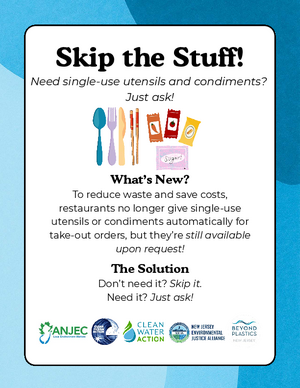
New Jersey's "Skip the Stuff" law requires food service establishments to provide single-use plastic utensils and condiment packets only upon a customer's express request. The law aims to dramatically reduce plastic pollution and landfill waste, curbing the billions of unused disposable items that end up in waterways, oceans, and kitchen junk drawers. By shifting the default option to an "opt-in" model, New Jersey hopes to drastically cut down on unnecessary plastic litter while simultaneously saving local restaurants money on supply and disposal costs.
On August 7, 2026, the New Jersey Department of Environmental Protection (NJDEP) will host Cindy Zipf, Executive Director of Clean Ocean Action (COA) and Chair of the New Jersey Plastics Advisory Council (PAC), as a featured speaker for its Sustainability Series to highlight the environmental milestones of moving toward a culture of reducing, reusing, recycling, and refusing single-use items. COA's Marine Debris Intern, Adriana Whelan, will debut her targeted case study on the "Skip the Stuff" initiative, featuring insights gathered from interviews with businesses in Long Branch, New Jersey, which implemented a similar local ordinance in 2025. Adriana aims to investigate the tangible financial benefits to businesses and the measurable volume of plastic cutlery and condiments successfully diverted from regional waterways and landfills.
To learn more about the "Skip the Stuff" law, review our breakdown of its Key Provisions or view the full statutory text on the NJDEP's Get Past Plastic webpage.

Skip the Stuff (S3195/A5157) Becomes Law in New Jersey!
Plastic utensils are often provided to customers with takeout orders by default, often in excess. Many of these single-use plastics are found littering communities. Over the past decade, COA’s Beach Sweeps volunteers have removed more than 36,000 plastic forks, spoons, and knives from NJ beaches. Over the past 2 years, COA and other environmental advocates have supported a bill that would establish a statewide standard that reduces unnecessary single-use plastic waste by requiring food service businesses to provide plastic utensils and condiment packets only when requested.
COA's Plastic-Free Sea Coordinator, Meg Sulzberg, and high school SEAL student, Landon Hoberman, both testified in favor of the bill. On January 20, 2026, Governor Phil Murphy signed Skip the Stuff (S3195/A5157) into law, marking a major victory for the ocean, local communities, and the environment. The law takes effect on August 1, 2026 and replaces all preexisting ordinances and resolutions.

COA’s Plastic-Free Sea Coordinator Meg Sulzberg (right) and Clean Water Action’s Marta Young (left) testify on January 9, 2026
Clean Ocean Action applauds the leadership of the bill’s sponsors, whose commitment helped turn local action into meaningful statewide change.
Primary Sponsors:
Bob Smith, Raj Mukherji, Alixon Collazos-Gill, Margie Donlon, M.D., Shama A. Haider
Co-Sponsors:
Linda R. Greenstein, Andrew Zwicker, John F. McKeon, Britnee N. Timberlake, Benjie E. Wimberly, Patrick J. Diegnan Jr., Renee C. Burgess, Ellen J. Park, Clinton Calabrese, Verlina Reynolds-Jackson, James J. Kennedy, Luanne M. Peterpaul, Esq.
Skip the Stuff is a critical step toward cleaner beaches, a healthier ocean, and a more sustainable future for New Jersey!

REDUCE Plastic Packaging!
Clean Ocean Action's 2024 Beach Sweeps Data Shows:
- over 80% of beach litter is plastic
- 41% of all debris collected is packaging
- 48% of the top 12 items collected is packaging
We need less plastic packaging to reduce waste, litter, and fossil fuel use.
In New Jersey, help support the passage of a strong Packaging Product Stewardship Act (S3398/ A5009), introduced by Senator Bob Smith and Assemblymember Alixon Collazos-Gill,which will:
- Reduce packaging by 50% over 10 years,
- Make the remaining packaging reusable or recyclable.
- Get the most harmful toxic chemicals out of packaging.
- Pay for clean up of their packaging waste by reimbursing municipalities and taxpayers for the collection and processing of those materials.
- The bill would also prohibit incineration and "chemical recycling"from counting as recycling.
What Can YOU Do?
- LEARN more about the NJ Packaging Product Stewardship Act with this quick one-page summary
- ASK your municipality to adopt this Model Resolution to support the NJ Packaging Product Stewardship Act to reduce packaging
- SIGN and SHARE a Petition supporting the NJ Packaging Product Stewardship Act. Upon signing, you will also be asked to go to the Email campaign targeting your own legislators.
Earth Day 2024 Press Conference on Plastic Pollution

Clean Ocean Action participated in an Earth Day press conference at the State House in Trenton, NJ. The press conference, held with other environmental groups, followed a special Joint NJ Senate and Assembly Committee hearing focused on the effects of plastics on human health. A screening of the documentary, “We’re All Plastic People Now,” followed.
COA spoke about the success of NJ’s Get Past Plastic Law in reducing plastic waste. COA used data and debris collected at our Beach Sweeps litter cleanups to illustrate that plastic bag and foam plastic food service litter has decreased, but plastic pollution remains a serious problem. Plastic is man-made from fossil fuels, never fully degrades, and has a toxic life cycle which threatens public health and the environment. Plastic waste in the ocean also maims, harms or kills marine life through ingestion and/or entanglement.
Since 1984, COA has worked to implement the most effective policies to reduce and eliminate plastics, especially single-use plastics. The work continues and the Beach Sweeps program provides evidence of the persistent plastic pollution problems that still must be addressed.
Photo by Jo Arlow Photography taken at COA's Spring 2024 Beach Sweeps, Plum Island B.
Wave Goodbye to Plastic Carryout Bags & Foam Plastics! (And Skip the Straw, too!)

Good job, New Jersey! In just 5 months of the full law coming into effect in May 2022, the New Jersey Food Council estimates that 3.44 BILLION plastic bags and 68 million paper bags have been eliminated from the waste stream as a result of this law! In addition, 8.4 million single-use bags are not being distributed annually! Clearly, the law is having a positive impact on our communities and the environment. Keep it up!
On May 4, 2022, the Single-Use Waste Reduction Act (P.L.2020, c.117) came into effect. This law significantly restricts the availability of single-use plastic bags, polystyrene food service products, and single-use paper bags within the Garden State. More information about the law and the upcoming implementation of its provisions concerning single-use plastic bags, single-use paper bags, polystyrene foam food products, and plastic straws can be found on NJDEP’s website at www.nj.gov/dep/get-past-plastic. NJDEP has also indicated that any comments or questions about the law for the Department should be submitted via email to singleuseplastics@dep.nj.gov or via telephone at (609) 984-4250.
Here is a quick summary of the law's requirements:
Single-use carryout plastic bags
May not be provided or sold to a customer by any store or food service business
Exceptions
- A bag used solely to contain or wrap uncooked meat, fish, or poultry
- A bag used solely to package loose items (e.g., fruits, vegetables, nuts, coffee, grains, baked goods, candy, greeting cards, flowers, or small hardware items)
- A bag used solely to contain live animals, such as fish or insects sold in a pet store
- A bag used solely to contain food sliced or prepared to order, including soup or hot food
- A laundry, dry cleaning, or garment bag
- A bag provided by a pharmacy to carry prescription drugs
- A newspaper bag
Single-use paper carryout bags
May not be provided or sold to a customer by any grocery store
“Grocery store” includes any self-service retail establishment that occupies at least 2,500 square feet and sells household foodstuffs for off-site consumption.
Household foodstuffs include, but are not limited to: fresh produce, meat, poultry, fish, deli products, dairy products, canned foods, dry foods, beverages, baked foods, or prepared foods
“Grocery store” does not include an establishment that handles only prepackaged food that does not require time or temperature controls for food safety
Polystyrene food service products
No food service business may provide or sell any food in a polystyrene foam food service product
No one may sell or offer for sale any polystyrene foam food service product
Products exempt until May 4, 2024:
- Disposable, long-handled polystyrene foam soda spoons when required and used for thick drinks
- Portion cups of two ounces or less if used for hot foods or foods requiring lids
- Meat and fish trays for raw or butchered meat, including poultry or fish that is sold from a refrigerator or similar retail appliance
- Any food product pre-packaged by the manufacturer with a polystyrene foam food service product
NJDEP is authorized to issue one-year waivers for the prohibition on polystyrene foam food service products, but food service businesses must apply for a waiver and NJDEP has not yet prescribed the form or manner for waiver applications.
Notably, in addition to authorizing the NJ Department of Environmental Protection (“NJDEP”) to enforce the provisions, the law authorizes all municipalities to enforce the new legal framework as well.
The law’s provisions concerning single-use plastic straws have already been in effect for six months. Since November 4, 2021, all food service businesses have been able to provide single-use plastic straws to customers only upon request. Unlike the other provisions of the law, which are jointly enforced by municipalities and NJDEP, it is the New Jersey State Department of Health that shares responsibility with municipalities for enforcing the restrictions on single-use plastic straws.