📢 Calling all Veterans and New Recruits of the Old Mud Dump!
Remember the Muck Monster?
Public Meetings this Week!
Changes are coming to the management of the old Mud Dump Site…let’s ensure that the changes continue to protect the ocean and implement environmentally proactive on-land alternatives.
Member of an environmental group? Fish in the Mud Hole and harbor area? Participate in the dredge wars of the past? We won a tremendous victory for the harbor and the ocean and must keep that progress moving forward!
Public meetings were held in late June. Wathc them here: https://www.youtube.com/watch?v=jL13emsVtuU
The public comment deadline was EXTENDED to August 3, 2025 by 11:59pm!
CLICK HERE FOR THE ANNOUNCEMENT UNDER PUBLIC REVIEW.
MDS/HARS brief history & new proposals:
• The toxic Mud Dump Sites (MDS) off the coast of NY-NJ with the legacy contamination of dioxins and PCBs and other pollutants that harm the marine ecosystem are well known.
• The establishment of the HARS (Historic Area Remediation Site) in 1997 off the coast of Sandy Hook, NJ, was a decades-long historic effort by several communities and stakeholders to remediate (cleanup) the toxic mud dump sites (MDS).
• HARS is managed by the US Environmental Protection Agency (EPA) Region II to reduce impacts of historical disposal activities.
• HARS is reaching capacity more quickly than the predicted 30 years.
• More than 40 million cubic years (MCY) of dredged material will be generated from the NY-NJ Harbor in the next twenty years.
• EPA Region II is evaluating alternatives for continued ocean management of these dredged materials. CLICK HERE FOR THE ANNOUNCEMENT UNDER PUBLIC REVIEW.
• EPA is considering to use material beneficially.
• An alternative may be a NEW site.
We must work together to make sure that the proposed alternatives for ocean management of these dredged materials are consistent with the highest environmental standards and do not usher in toxic mud dumping in the ocean again.
📣 Learn about the latest proposals.
• EPA hosted two virtual public scoping meetings (June 24, 2025, 1-3 PM, and June 26, 2025, 4-6 PM). View the meetings here: https://www.youtube.com/watch?v=jL13emsVtuU
• Link to EPA supplemental factsheet
📝 SUBMIT YOUR COMMENTS to advocate for the ocean.
• Email comments to Region2_MPRSA@epa.gov by 11:59 pm on August 3, 2025.
Historic Area Remediation Site (HARS)
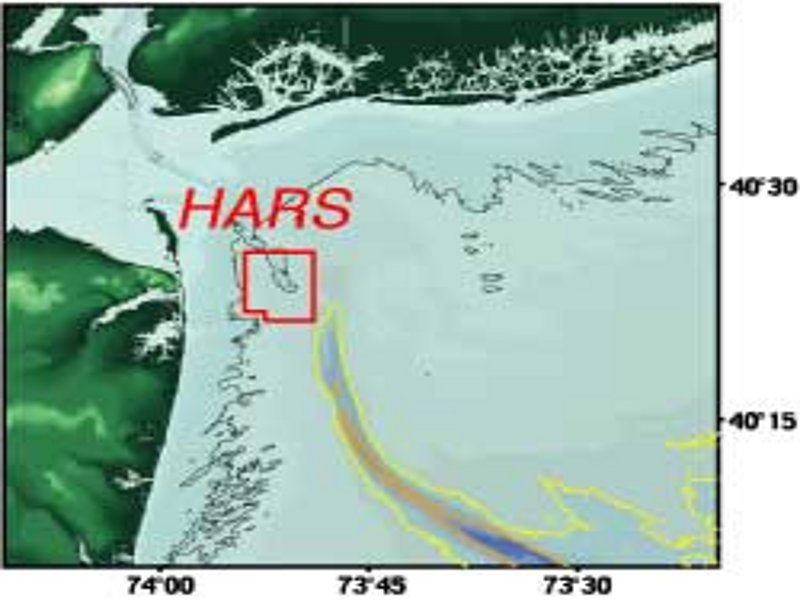
On September 1, 1997, the Historic Area Remediation Site (HARS), located in the New York Bight Apex, was designated under the Marine Protection, Research, and Sanctuaries Act as an ocean remediation site.
The HARS is a 15-square nautical mile benthic area that was concluded by the EPA to be contaminated (USEPA, 1997b). It surrounds the original Mud Dump Site, where contaminated dredged sediments from NY/NJ Harbor were dumped for decades. The dumping caused mounds of sediments in the 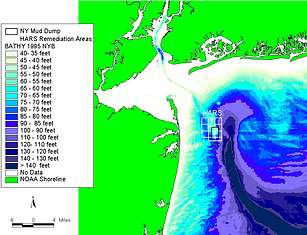 ocean area, forming new benthic habitat typically of fine particle silts and clays. This not only modified the benthic community type because of sediment particle size, but also because these fine grained harbor sediments were highly contaminated.
The original Mud Dump site was 2-square nautical miles and the resulting remediation site (HARS) is nearly 15-square nautical miles. Baseline surveys of the HARS prior to its designation showed that sediment contamination was high, with possible negative biological effects (USEPA, 1997b). In particular, multiple contaminant levels exceeded sediment quality guidelines, sediments were acutely toxic to shrimp-like amphipods, and infaunal worms were accumulating high levels of specific contaminants from the sediments. Contaminants accumulating in the food chain were PAHs, PCBs, and 2,3,7,8-TCDD dioxin.
The HARS example illustrates the fact that once sediments are contaminated, results are system-wide and not limited to the seafloor benthic environment. Processes of bioaccumulation and trophic transfer through the food chain distribute contaminants to the entire marine system. The benthos is the beginning of this chain, bringing contamination in concentrated forms to species higher in the food chain.
In the NY Bight Apex, area lobsters were and still are contaminated with PCBs and 2,3,7,8-TCDD (dioxin). The HARS area is one culprit for this contamination. According to NOAA (1996, as cited in USEPA, 1997b), total PCB (å18PCB) concentrations in muscle and hepatic tissue were elevated in lobsters from three sampling areas closest to the historical mud dump site (now within the HARS area) in comparison to the Hudson Shelf Valley, and this spatial trend was consistent over time. Concentrations ranged from 1.8 to 7.4 ppm (wet weight) in the hepatic tissue (NOAA, 1996 as cited in USEPA, 1997).
The HARS is now being capped with dredged sediments from New York/New Jersey Harbor. This cap material is termed "Material for Remediation." Since its designation and the beginning of the capping process, there has been considerable debate over standards for the cap material. In fact, no new standards were developed for the purposes of remediating the site except for PCB's (in October 2000, the EPA and Army Corps implemented an updated PCB guideline).
As of May 2002, standards are being developed through a lengthy peer review process. Meanwhile, sediments are being dumped at the HARS. Some of these sediments are contaminated and contain levels of contamination that exceed those in the HARS prior to capping. In other words, the federal agencies are placing contaminated sediments to "cap" contaminated sediments. Other sediments from some dredging projects have levels of contamination that indeed are cleaner than the original contamination at the site.
COA is active in the various policy and technical workgroups for development of standards and carefully reviews all sediments proposed for HARS.